
- This event has passed.
Moving People Safely in Domiciliary Care (25/08/26)
Moving People Safely in Domiciliary Care
Moving people safely in domiciliary care requires practical skills, careful planning and a person centred approach.
This six hour face to face course helps care workers support people with mobility, transfers and repositioning. It also shows learners how to protect dignity, independence and safety while working in a person’s own home.
Every home environment is different. Staff may encounter restricted space, unsuitable furniture, clutter, pets or equipment that has been moved or stored incorrectly. A person’s strength, balance or mobility may also change between visits. Therefore, care workers need to assess each situation before providing support.
This practical course develops the knowledge, confidence and skills needed to move and assist people safely.
Who is this course for?
The course is suitable for domiciliary care workers, home care workers, personal assistants, support workers and community care staff.
It is also suitable for new employees who require practical moving and handling training, as well as experienced staff who need to refresh or develop their skills.
No previous moving and handling qualification is required.
What does the course cover?
Learners will explore their responsibilities when moving and assisting people. They will consider the risks linked to unsafe practice and learn how safer movement principles can reduce the chance of injury.
The course also covers communication, consent, dignity, choice and independence. Learners will discuss how to encourage people to use their own abilities wherever it is safe to do so.
Risk assessment is included throughout the day. Learners will look at individual care plans, moving and handling assessments, equipment requirements and changes that may make a planned movement unsafe.
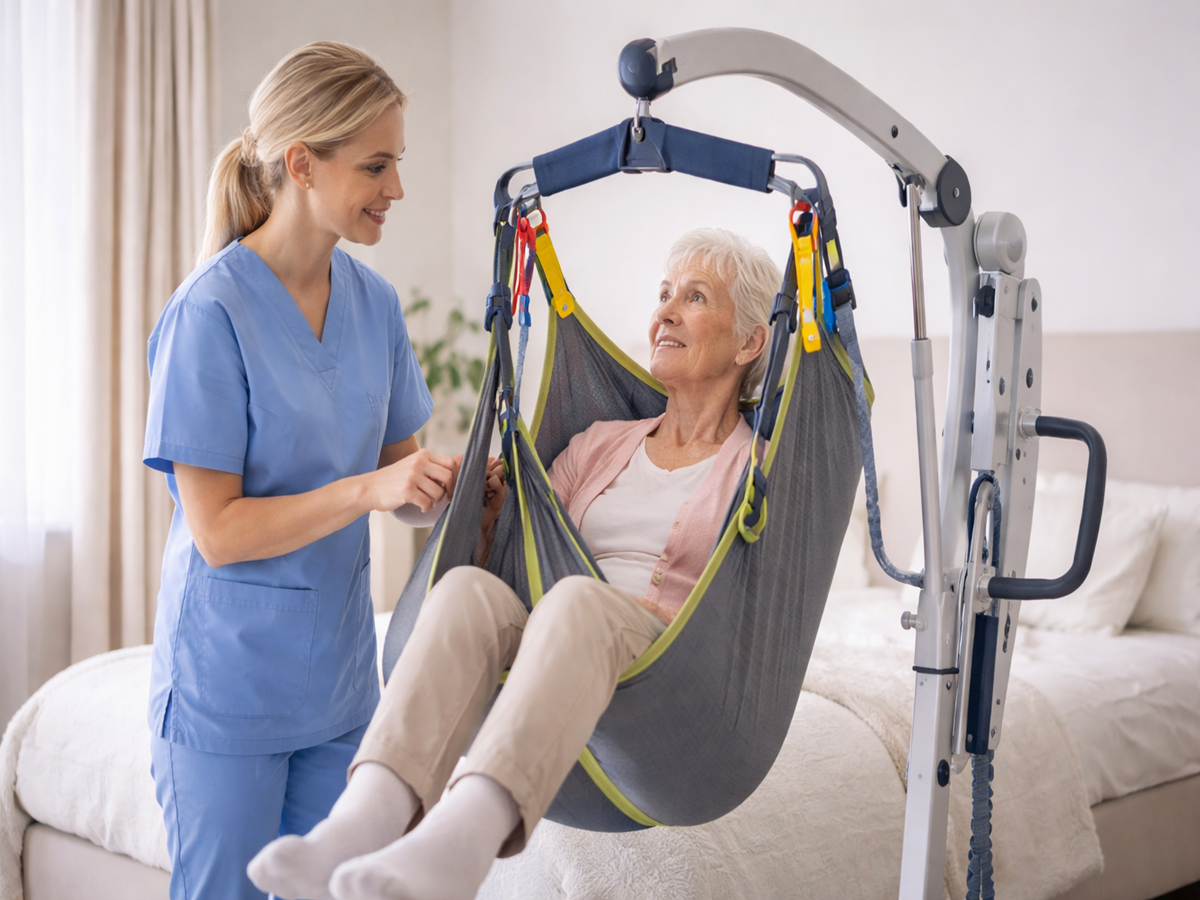
Practical topics include sitting, standing, transferring, repositioning, bed mobility and chair repositioning. Learners will also explore the use of slide sheets, transfer aids, mobility equipment, hoists and slings where appropriate.
Falls awareness, equipment checks, incident reporting and knowing when to stop and seek advice are also included.
Practical moving and handling training
This is an interactive course. Learners will take part in demonstrations, guided practice and realistic domiciliary care scenarios.
Practical activities may include supporting a person from sitting to standing, helping someone sit safely, repositioning in a chair or bed and using slide sheets or transfer aids.
Learners may also practise preparing the environment, checking equipment and responding to unexpected changes during a home visit.
The exact equipment used may depend on the needs of the learner group. However, staff must always follow the person’s current care plan, risk assessment and agreed moving and handling procedure.
Moving people safely in a person’s home
Domiciliary care can present challenges that are not normally found in a residential care setting.
Workers may find limited space around beds and chairs, low sofas, unsuitable furniture, clutter, pets or uneven flooring. Relatives and visitors may also be present during the task.
In some cases, furniture may have been moved since the last visit. Equipment may be missing, damaged or stored incorrectly. A second care worker may also be unavailable.
Because of this, workers should check the person, the environment and the equipment before starting.
Learners will discuss when it is safe to continue. They will also learn when to stop, report a concern or request a new assessment.
Person centred moving and handling
Safe moving and handling is not only about technique.
Workers should explain what is going to happen and involve the person throughout the movement. Where possible, the person should be encouraged to take part and use their own abilities.
This approach supports dignity, confidence, independence, comfort and choice.
Learners will also explore how pain, fear, tiredness or illness may affect a person’s ability to move safely.
Risk assessments and care plans
Before supporting a person, staff should check the current moving and handling plan.
The plan should explain what the person can do, what support they need and which equipment should be used. It may also state how many workers are required and which techniques have been assessed as suitable.
However, a written plan does not replace an immediate safety check.
Workers should pause if the person appears weaker, unwell, frightened or unable to follow the planned movement. They should also stop if equipment is missing, damaged or unsuitable.
Equipment safety
Learners will explore the safe use of equipment that may be found in domiciliary care.
This may include slide sheets, transfer boards, turntables, handling belts, standing aids, mobile hoists, slings and mobility aids.
The course also covers basic pre-use checks and the importance of using the correct equipment for the person.
Workers should not use equipment that is damaged, unsuitable or different from the equipment listed in the care plan. Any defect or concern should be reported promptly.
Hoists and slings
Where relevant, learners will explore different types of hoist and sling.
The course will consider sling identification, attachment points, safe working loads, compatibility, positioning and pre-use checks.
Learners will also discuss communication, reassurance and signs that equipment may be damaged or unsuitable.
Hoists and slings should only be used when they are suitable for the person and included within the assessed moving and handling plan.
Falls and the fallen person
The course also considers what staff should do if a person falls or is found on the floor.
Learners will explore immediate safety, checking the person, calling for suitable help and avoiding unsafe lifting.
They will also discuss following the person’s falls plan, reporting the incident and seeking medical advice where required.
Workers should never attempt an unsafe manual lift simply because a person wants to get up quickly.
What will learners achieve?
By the end of the course, learners should understand their moving and handling responsibilities and be able to identify common risks within domiciliary care.
They should be able to follow a moving and handling plan, prepare the person and environment, check equipment and apply safer movement principles.
Learners should also be able to recognise unsafe situations, respond to changes in mobility and know when to stop and seek further advice.
Assessment
Learners are assessed throughout the course through trainer questions, discussion, practical activities and realistic domiciliary care scenarios.
Practical skills will be observed during the session. Learners must demonstrate safe practice to complete the course successfully.
Certificate
Successful learners will receive a Moving People Safely in Domiciliary Care certificate.
Annual refresher training is recommended. Earlier training may be needed following an incident, a change in equipment or a change in the needs of the people supported.
Important competency information
Completing this course provides evidence of training and practical assessment within the training environment.
However, employers remain responsible for checking workplace competence.
Workers must also understand the care plan, equipment and risks linked to each person they support.
Additional workplace assessment may be required when new equipment is introduced, a person’s needs change, a worker changes role or unsafe practice is identified.
Course information
Course: Moving People Safely in Domiciliary Care
Duration: Six hours
Delivery: Face to face practical training
Location: Training in Partnership, The Chantry Centre, Andover, Hampshire
Assessment: Knowledge and practical competency assessment
Certificate: Certificate of completion
Please wear comfortable clothing and flat, enclosed footwear because the course includes practical activities.
Why choose Training in Partnership?
Training in Partnership provides practical and inclusive training for health and social care staff.
Learners benefit from an experienced trainer, realistic scenarios, hands-on learning and time to practise in a supportive environment.
Our courses focus on useful skills, confidence and safe practice rather than simply completing a compliance exercise.
You can view our full range of health and social care training courses or learn more about our on-site training options.
Book moving people safely in domiciliary care training
Book your place using the ticket section below.
Places are limited so that every learner has enough time to practise and complete the practical assessment.
Organisations booking several employees can contact Training in Partnership to discuss invoicing, group bookings or training at their own workplace.
For further guidance, visit the Health and Safety Executive’s moving and handling guidance. The HSE also provides specific information about care delivered in people’s own homes.