
- This event has passed.
Basic Life Support for Health & Social Care Staff
Basic Life Support Training for Health & Social Care Staff
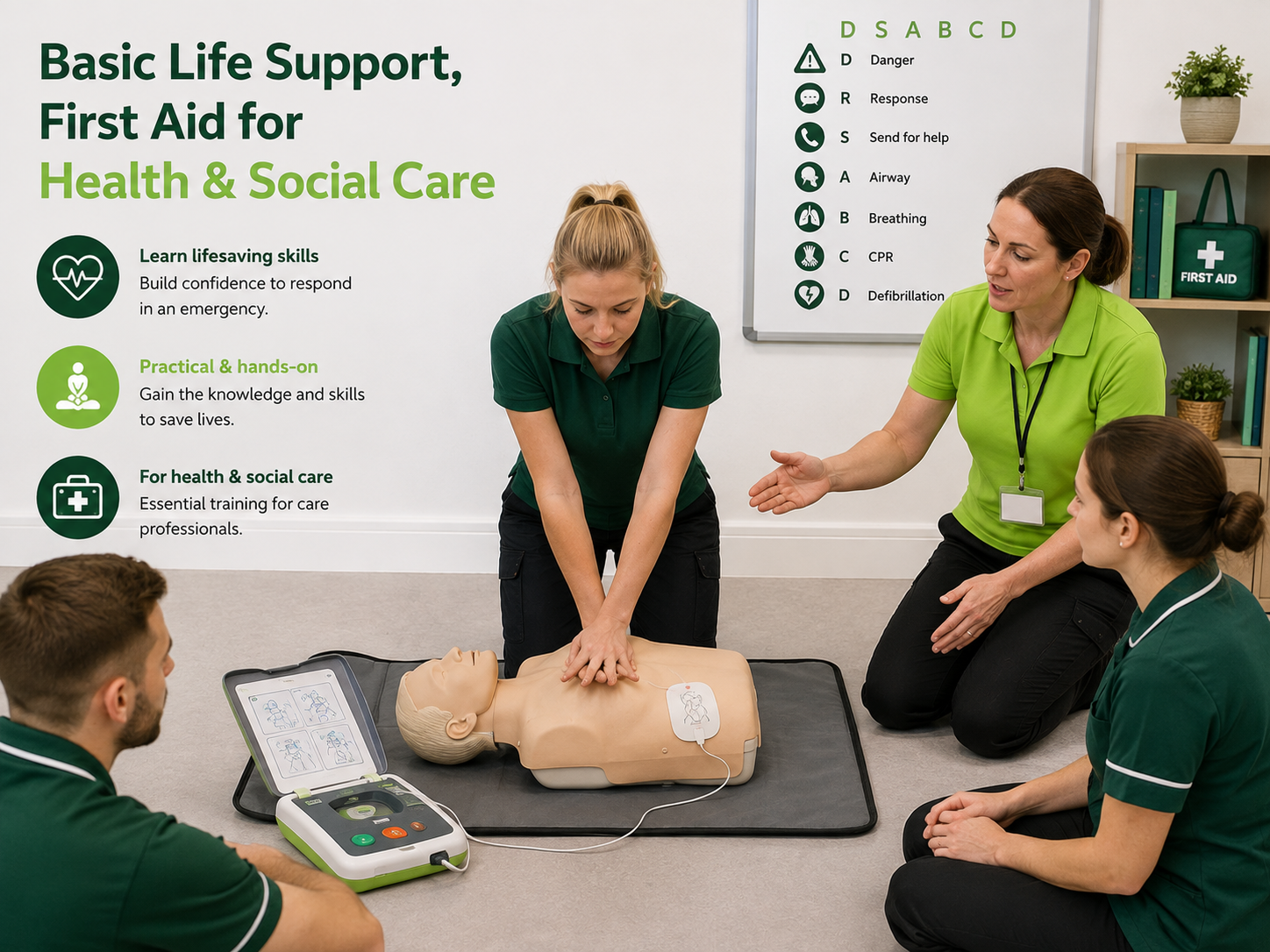
Basic Life Support Training gives health and social care staff the practical skills and confidence to respond effectively when someone collapses, stops breathing normally or experiences a life-threatening emergency. This interactive three-hour course includes hands-on CPR, AED use, casualty assessment, recovery position and choking management.
The session combines clear theoretical instruction with hands-on practical activities, including CPR and the safe use of an Automated External Defibrillator (AED).
Who is this course for?
This course is suitable for staff working across the health and social care sector, including:
- Care assistants
- Healthcare assistants
- Support workers
- Senior carers
- Domiciliary care workers
- Supported living staff
- Residential and nursing home staff
- Day service staff
- Personal assistants
- Rehabilitation and community support staff
- New employees completing induction
- Existing staff requiring Basic Life Support refresher training
It can also be adapted to reflect the needs, policies and working environment of individual care organisations.
Course Duration
3 Hours – Face-to-Face Practical Training
The course includes both knowledge-based learning and practical skills practice.
What Will the Course Cover?
During this course learners will explore:
Understanding Basic Life Support
- What Basic Life Support is
- Why early intervention is important
- The role and responsibilities of health and social care workers during an emergency
- Maintaining personal and scene safety
Assessing a Casualty
Learners will practise a structured approach to assessing someone who has collapsed, including:
- Checking for danger
- Assessing responsiveness
- Opening and maintaining the airway
- Assessing breathing
- Recognising normal and abnormal breathing
- Knowing when to summon emergency assistance
Recognising Cardiac Arrest
Learners will explore:
- Signs that may indicate cardiac arrest
- The importance of recognising an unresponsive person who is not breathing normally
- Activating the emergency response
- Calling 999 and communicating effectively with emergency services
- Obtaining emergency equipment and an AED
Cardiopulmonary Resuscitation – CPR
Learners will receive practical CPR training, including:
- Correct positioning of the casualty
- Correct hand position
- Performing effective chest compressions
- Compression depth and rate
- Allowing full chest recoil
- Minimising interruptions to CPR
- Rescue breaths where appropriate
- Compression-only CPR
- Working with another responder
- Continuing CPR until further help arrives
Learners will have the opportunity to practise CPR using appropriate training manikins.
Automated External Defibrillators – AEDs
Learners will learn how to use an AED confidently and safely, including:
- What an AED is
- Why early defibrillation is important
- Locating and accessing an AED
- Preparing the casualty
- Correct AED pad placement
- Following the AED’s voice and visual prompts
- Safety during rhythm analysis and shock delivery
- Continuing CPR alongside AED use
Practical AED scenarios will be incorporated into the session.
Recovery Position
Learners will practise:
- When the recovery position should be used
- Safely positioning an unconscious person who is breathing normally
- Maintaining and monitoring the airway
- Continuing to monitor the person’s condition while awaiting assistance
Choking
The course will cover the recognition and immediate management of an adult who is choking, including:
- Recognising mild and severe airway obstruction
- Encouraging effective coughing
- Back blows
- Abdominal thrusts
- When to call 999
- What to do if the person becomes unresponsive
Resuscitation in Health & Social Care
The course also considers situations specifically relevant to care environments, including:
- Raising the alarm within the workplace
- Working effectively with colleagues during an emergency
- Accessing emergency equipment
- Person-centred emergency care
- Infection prevention considerations during resuscitation
- Handover to emergency medical services
- Following organisational emergency procedures
- Recording and reporting an emergency following the event
DNACPR and ReSPECT Awareness
Health and social care workers may support people who have documented decisions or recommendations relating to cardiopulmonary resuscitation.
The course therefore provides appropriate awareness of:
- DNACPR documentation
- ReSPECT documentation where applicable
- The importance of checking and following valid documentation
- Following organisational policies and procedures
- Working within individual roles and responsibilities
- Escalating concerns where documentation or instructions are unclear
This element provides awareness and does not replace organisation-specific policies, clinical decision-making or professional guidance.
Practical Assessment
This is a practical course and learners will be expected to participate in practical activities.
Assessment may include:
- Casualty assessment
- Demonstration of adult CPR
- Safe use of an AED
- Recovery position
- Choking management
- Scenario-based emergency response
- Trainer questioning and knowledge checks
Learners will receive supportive feedback throughout the session.
Our Basic Life Support training reflects current UK resuscitation principles, including early recognition of cardiac arrest, high-quality CPR and early use of an AED.
Group and Workplace Training
This course can be delivered for individual organisations at their own premises or at a suitable training venue.
Bespoke sessions can incorporate your organisation’s:
- Emergency procedures
- Client group
- Policies and procedures
- Emergency equipment
- Care environment
- Staff roles and responsibilities
Please contact Training in Partnership to discuss group bookings, workplace delivery or bespoke training requirements.